
Articles
Urban Development
May 13, 2026

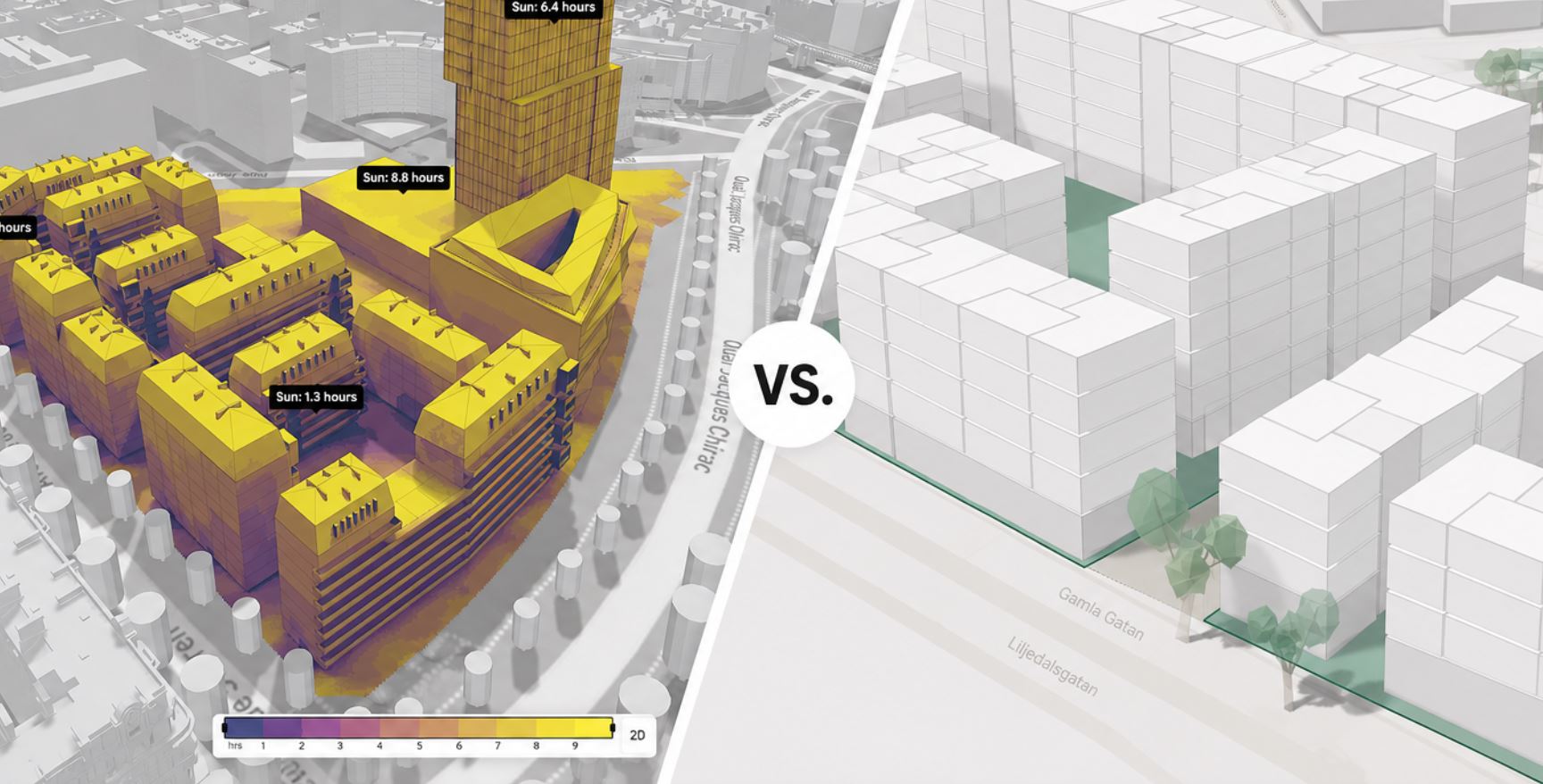

In November 2020, Autodesk bought a Norwegian startup called Spacemaker for $240 million. Three years later, they rebranded it as Forma. Today it sits at the center of Autodesk's AEC industry cloud strategy, integrated with Revit, bundled into the AEC Collection, and marketed as the answer to early-stage site planning for architects worldwide.
If you are reading this, you are probably weighing Forma against Hektar. We are going to make the case that these are not the same kind of tool, despite surface similarities.
One disclaimer up front: We build Hektar. This is not a neutral review. It is, we hope, an honest one. Verify everything with Autodesk before you spend money.
To understand Forma, you have to understand what Spacemaker was. It was built in Oslo around a specific premise: that the bottleneck in early-stage architecture is environmental analysis. Sun studies. Wind comfort. Noise. Microclimate. Things that traditionally required specialist consultants and weeks of turnaround.
Spacemaker compressed that into a real-time experience. You draw a massing on a site, the analysis updates instantly, and you iterate. The technology was good enough that Autodesk paid almost a quarter billion dollars for it.
Forma inherits this DNA. The current product is officially called Forma Site Design, and the environmental analysis suite is still the deepest in the category. Sun hours, wind comfort, daylight potential, noise modeling, microclimate, embodied carbon, operational energy. Forma Building Design is entering general availability in 2026 to extend the platform into schematic phase at LOD 200-300.
This is what Forma does well. It is genuinely the best tool on the market if your decision hinges on environmental performance analysis at the site level.
Hektar was not built to answer the same question. We started from a different observation: that the earliest decisions in raw land development are not about wind comfort. They are about whether anything viable can be built at all.
A developer looking at an unbuilt parcel in Växjö or Trondheim is not asking, "What is the optimal wind comfort here?" They are asking, "What does the detaljplan allow? What does the Lantmäteriet data show about the parcel boundaries? What typology fits the road network and the noise context? Can we get to a viable density?"
These are the questions Hektar's zone tools and generative engine are built around. The platform produces feasible block configurations from regulatory constraints, not optimizations of pre-defined massings. The architectural scales structure means analyses run at the scale the decision requires.
Put differently: Forma assumes the site question is answered and helps you optimize the building. Hektar assumes the building question is open and helps you figure out what is even possible.
The headline price is $185 per month or $1,445 per year for standalone Forma. There is also a 30-day trial and free educational access. On paper, this is mid-tier pricing for a professional tool.
The real picture is different. Almost no one pays this. Architecture firms that use Forma already pay for the AEC Collection (roughly $3,000 per seat per year) for Revit access, and Forma is bundled into that. For these firms, Forma's marginal cost is effectively zero. The Autodesk ecosystem is the customer acquisition channel.
If you are outside that ecosystem, the calculation changes. You are paying $1,445 per year for a tool you might use heavily three months out of twelve, depending on your pipeline.
Hektar Pro starts at 250 SEK per month for 50 credits, with 750 SEK and 2,000 SEK tiers above. The starting price is roughly a tenth of standalone Forma. This is deliberate. We wanted municipal planners and small developer teams to be able to adopt the tool without going through procurement, and Forma's pricing structure doesn't allow for that.
Forma is typology-agnostic. You define the massing. The platform analyzes it. This works well for architects who want to design freely and check performance as they go. It is less helpful for developers who are not designers and need a sense of what typology fits before they commit to one.
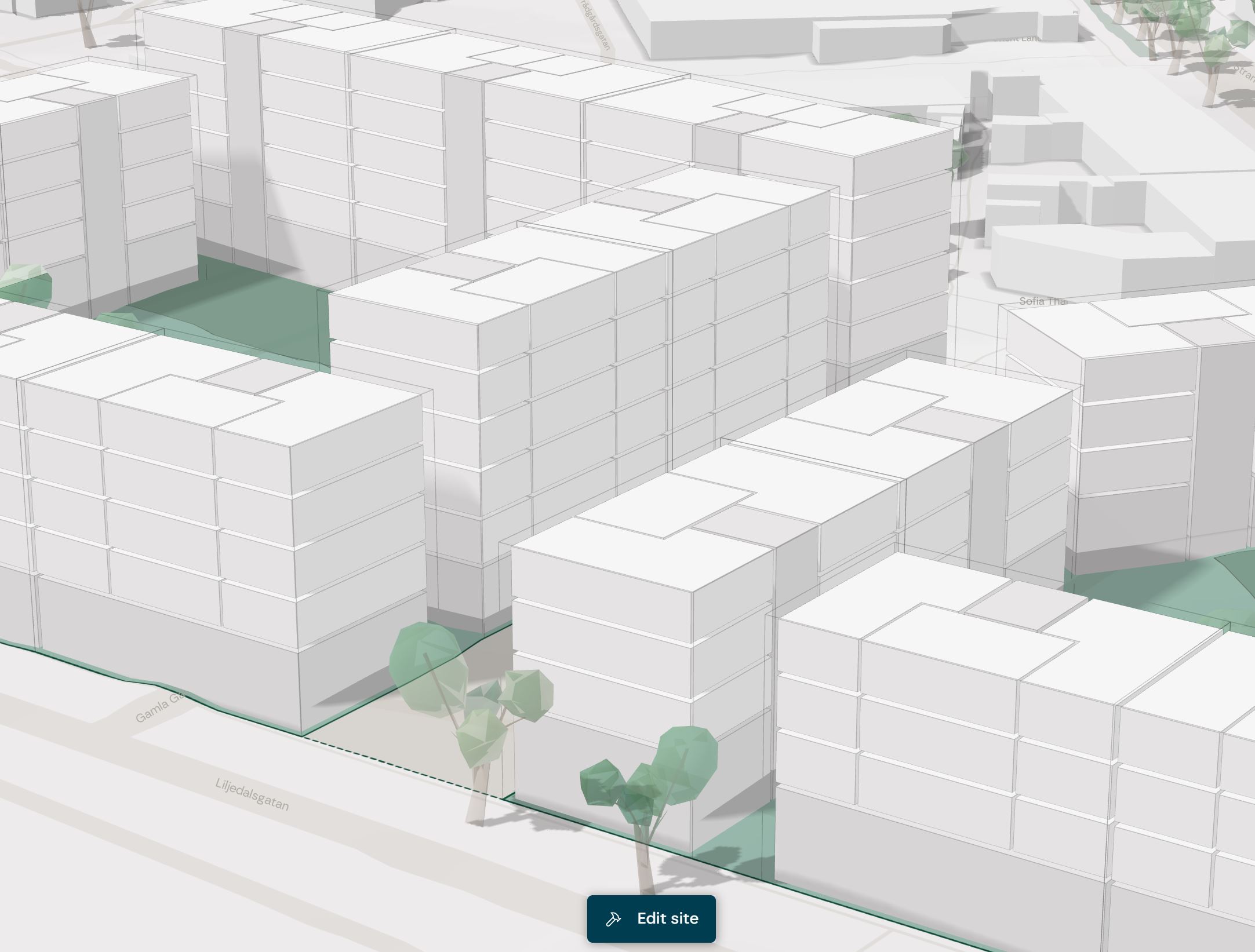
Hektar takes the opposite approach. The typology library codifies five volume types (Point, Lamella, L, U, Quarter) and four block plan access types (Corridor, Gallery, Point House, Lamella with staircase in facade). Combined, this produces more than 500 base parcel configurations. The system is opinionated about residential because Nordic raw land work is overwhelmingly residential.
If your work is bespoke and you want to design first, Forma's flexibility wins. If your work is exploratory and you want to test combinations rapidly, Hektar's library wins.
One way to think about this: a project goes through phases. Site identification. Raw land evaluation. Regulatory check. Typology selection. Massing decisions. Environmental optimization. Detailed design. Construction documentation.
Hektar lives in phases two through five. Forma lives in phases five through seven. There is some overlap at the massing-decisions step, but the tools are pointed at different problems.
This is why many Nordic teams use both. Hektar produces the feasibility scenarios that survive the regulatory and typology screen. Forma takes a chosen scenario into detailed environmental analysis. Each tool stays in its strongest zone.
Forma pulls real-world contextual data automatically when you set up a geolocated project. Terrain, existing buildings, roads, vegetation. The coverage is global, the quality varies by market, and the data is sufficient for the analyses Forma runs.
Hektar's data integration is narrower but deeper. Direct connections to Lantmäteriet (Sweden), BAG and AHN (Netherlands), and equivalent Norwegian and Danish sources. What you get is parcel boundaries, ownership data, detaljplaner and kommuneplaner as live regulatory layers, and building footprints at much higher fidelity than a globally-scoped tool can offer.
For projects in the four primary Nordic markets, this difference is decisive. Hektar can answer questions about ownership, regulatory boundaries, and historical context that Forma simply does not have the data to address.
If your firm's deliverable is Revit BIM, Forma is the obvious choice. The integration is the tightest in the category, two-way data flow, direct Dynamo connection, native Autodesk Construction Cloud integration. This is the entire point of being inside the Autodesk ecosystem.
Hektar exports to Rhinoceros (.3dm), generic OBJ, and Excel via the export scenario workflow. The handoff is one-way: you generate a scenario, you export it, you refine it elsewhere. For Rhino-centric European practices, this is fine. For Revit-centric firms, Forma's BIM integration is a meaningful advantage we do not match.
If you are an Autodesk-native architecture firm working on environmentally complex urban projects, Forma is the right answer. The bundled pricing makes it economically sensible, the environmental analysis suite is unmatched, and the Revit handoff is seamless.
If you are an architect, planner, or developer working on Nordic raw land where the regulatory and typology questions matter most at the earliest stage, Hektar is the right answer. The data integration is deeper, the pricing accessible, and the generative engine produces configurations the global tools cannot.
Many teams will end up using both at different points in the same project. That is the right answer for a lot of cases.
No. Autodesk retired the Spacemaker brand in May 2023. All capabilities migrated to Forma Site Design, with existing subscribers transitioned automatically.
No, and we are not trying to. Hektar's environmental analyses focus on Direct Sun Hours, Sky View Factor, and road noise. For pedestrian-scale wind comfort modeling, use Forma.
Yes, as a $185 per month or $1,445 per year standalone product. But the economics rarely make sense if you are not already an Autodesk customer.
You can use it globally, but the data integration is significantly deeper in Sweden, Norway, Denmark, and the Netherlands. For projects elsewhere, Forma's global data coverage is more practical.
Both have low onboarding friction. Forma's analysis-as-you-draw model is intuitive for architects. Hektar's generative configurations are intuitive for developers and planners who want to skip the manual modeling step. Pick the one whose primary metaphor matches your work.
Forma is a serious product built by a serious company. We respect what it does and we recommend it to people whose work fits its strengths. Hektar fits different work. The category is large enough for both tools to thrive, and the differentiation is real rather than marketing.
For other comparisons, see Hektar vs Giraffe, Hektar vs Finch3D, and Hektar vs TestFit. The five-tool market overview covers the full landscape.


