
Articles
Urban Development
February 26, 2026

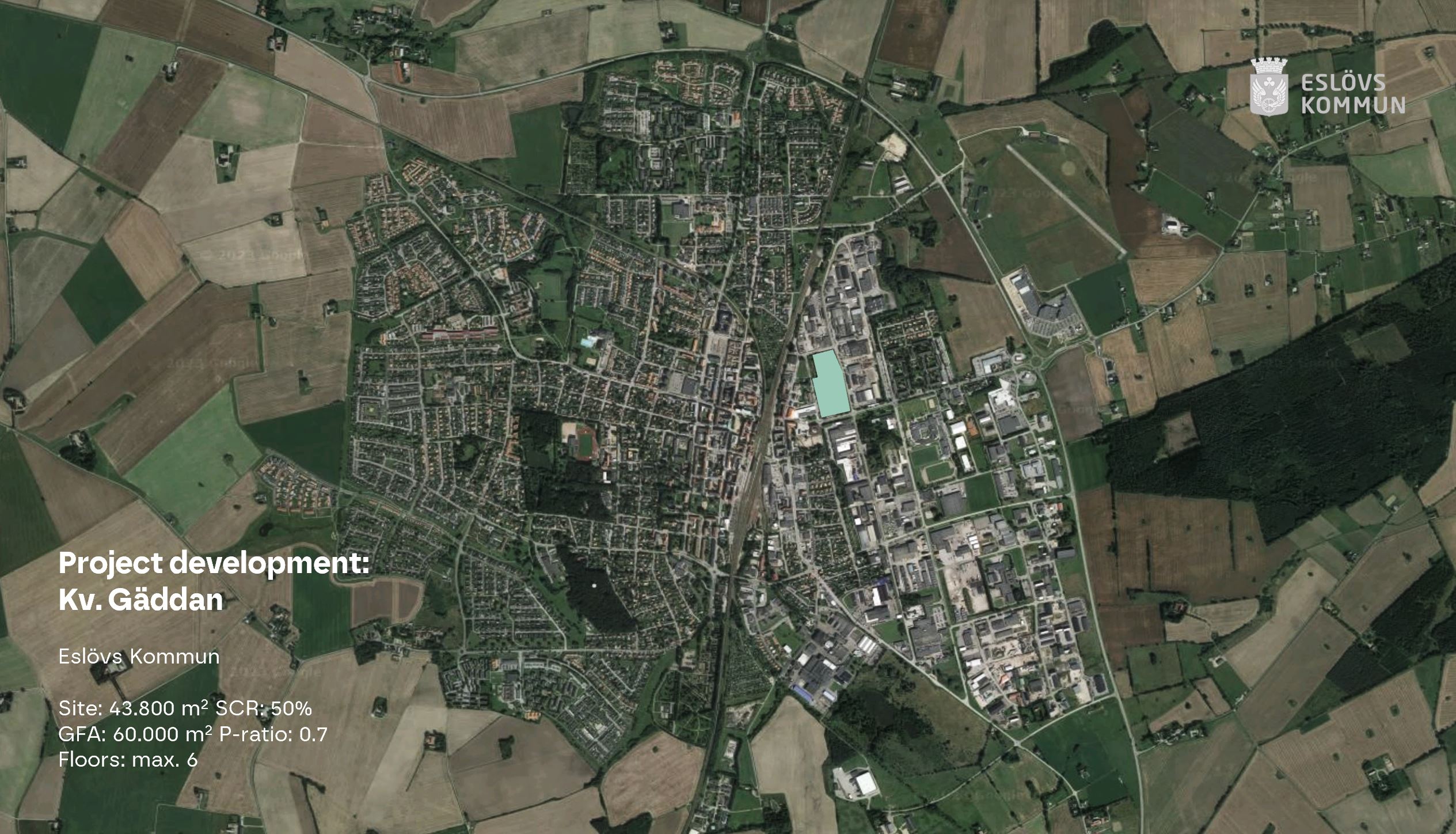

This article demonstrates how early-stage generative feasibility can beapplied to a real municipal housing target. Using a site in Eslöv, Sweden as anexample, we tested three alternative development concepts to reach 600 housingunits at 50% site coverage.
A municipality defines a clear objective:
At this stage, the key questions are not aesthetic. They are structural:
This is an early-stage feasibility problem.
For feasibility modeling, we assume:
The purpose is not final design. The purpose is spatial and quantitative validation.
A 50% coverage cap means:
Half the site must remain unbuilt at ground level.
This directly affects:
Without structured iteration, teams often default to one concept and refineit. Instead, we generated three fundamentally different spatial strategies.
Structure: Closed or semi-closed perimeter blocks
Footprint: Distributed evenly across the site
Height: 5–7 floors
With 50% coverage, perimeter blocks create:
To reach 600 units within the coverage limit, vertical stacking becomesnecessary.
This concept maximizes spatial clarity and repetition.
Structure: Parallel lamella buildings
Footprint: Linear distribution
Height: 6–8 floors
Lamellas reduce courtyard enclosure and increase:
However, to reach 600 units with 50% coverage, buildings must increase inheight compared to perimeter blocks.
This concept trades enclosure for openness.
Structure: Mid-rise base + selective point buildings
Footprint: Concentrated coverage nodes
Height: 4–10 floors
By concentrating footprint in select areas, more open ground can bepreserved elsewhere.
Towers allow unit count to increase without expanding ground coveragebeyond 50%.
This concept introduces more spatial diversity but higher structural andcoordination complexity.
All three concepts achieve:
They very in quality.
The feasibility question is not “which looks best.”
It is:
Which risk profile matches the municipality's objective?
In traditional workflows, one concept would be drawn manually and refined.
In a generative feasibility workflow:
The 50% coverage rule becomes a design driver rather than a late-stagelimitation.
When municipalities state targets like:
“600 units on this site”
the implicit challenge is balancing:
Testing only one spatial strategy introduces path dependency.
Testing multiple strategies early compresses risk before political andfinancial commitments are made.
Tools like Hektar enable:
Instead of asking:
“Can we make this one concept work?”
The question becomes: “What spatial strategy best aligns with the site's constraints andpolitical objectives?”
That shift is fundamental.
Early-stage feasibility is not about producing architecture.
It is about:
In the Eslöv case, 600 units at 50% coverage is feasible.
But how it is achieved dramatically changes urban form, height profile, andopen space structure.
Generative feasibility allows these alternatives to be explored beforedesign direction hardens.
That is where the real leverage in development lies.


