
Articles
Urban Development
May 11, 2026

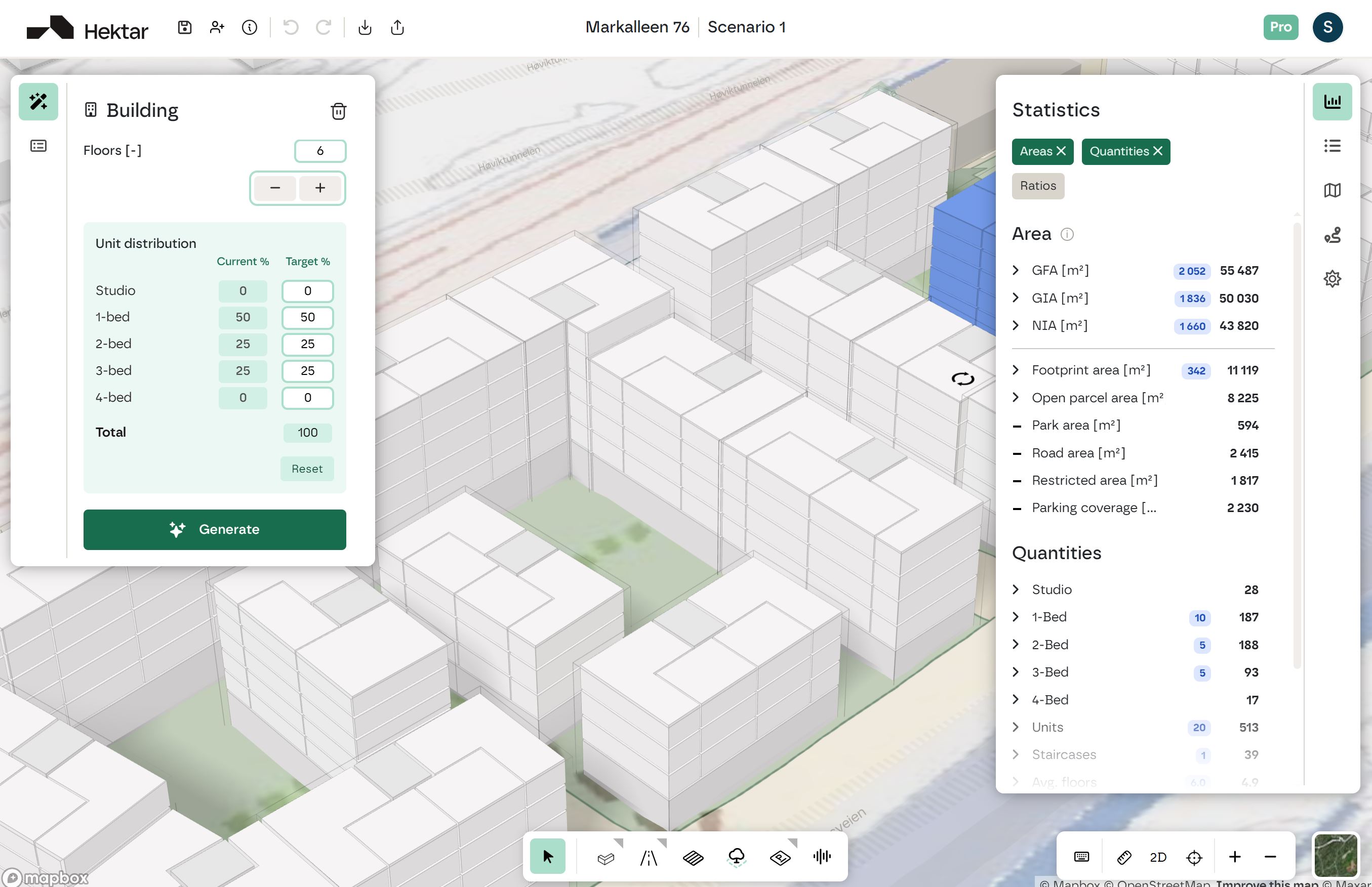

Density targets are deceptively simple. A municipality sets a floor area ratio of 1.2, a developer underwrites at 1.0, and a feasibility study is commissioned to confirm the number. The problem is that density is not a number you apply to a site. It is a result of how a site absorbs buildings, and most sites do not absorb them evenly.
This gap between target density and achievable density is where early-stage projects quietly lose money. Not through dramatic failures, but through small revisions that compound. A reduced footprint here, a lowered height there, a courtyard that needs to grow for daylight reasons. Each adjustment is rational on its own. Together they can erode a project's economics before the detaljplan process even begins.
Density on raw land comes from three levers: site coverage, building height, and typology. Treating them as independent variables is the most common mistake in early feasibility.
Site coverage and height are often presented as substitutes. Build low and wide, or build tall and narrow. In practice, they constrain each other through daylight, fire access, courtyard quality, and parking logistics. A perimeter block at four floors with 40 percent coverage produces a very different courtyard than the same coverage at seven floors. The numbers can be identical. The livability is not.
Typology is the lever most often left out of the spreadsheet entirely. A lamella layout, a perimeter block, a point tower, and a hybrid courtyard scheme can all deliver the same gross floor area on the same parcel. They will not deliver the same unit mix, the same daylight conditions, the same construction cost per square meter, or the same political reception. Choosing typology before testing it against the site is a path-dependent decision that quietly forecloses other options.
For a deeper look at how these forms behave differently, the building typologies learning article walks through the relationships between form, density, and site geometry.
Most raw land sites have zones that look buildable on a plan view but are not. Slope, noise contours, ground conditions, existing vegetation, infrastructure setbacks, and ecological protections all carve into the usable area. A 25,000 square meter site rarely offers 25,000 square meters of effective ground.
The traditional response is to apply rules of thumb. Subtract 30 percent for streets and public space. Assume noise constraints push facades back by 15 meters. Add a buffer for the stream. These shortcuts are useful for initial filtering, but they hide the interaction between constraints. A noise contour and a slope condition combined can produce a buildable area shaped in a way that no rule of thumb anticipates.
Constraint-aware generation flips this logic. Instead of reducing a site to a percentage, the tool reads the actual constraint geometry and tests where buildings can stand. The result is not a single answer but a set of viable layouts, each with a different density, typology mix, and risk profile. This is the approach behind our work testing 600 housing units on a municipal site, where the difference between rule-of-thumb density and constraint-aware density was substantial.
When a municipality and a developer disagree on density, they are rarely arguing about the same thing. The municipality talks about housing targets, urban form, and political acceptability. The developer talks about return on cost and absorption. Both are correct, and both are talking past each other.
A generative feasibility process reframes this conversation. Instead of negotiating a number, the parties can compare layouts. Three schemes at 1.0 FAR can look radically different. One produces a continuous urban front with active ground floors. Another produces taller, slimmer buildings with generous green space between them. A third concentrates volume to release a third of the site as public park. The density is the same. The political and architectural reception is not.
This is why we built Hektar's typology system the way we did. Each typology carries its own logic about coverage, height, and orientation. Comparing them on the same site reveals where density targets meet site reality.
There is a tendency in early-stage planning to treat constraints as deductions from an ideal scheme. The ideal is a clean rectangular site with maximum coverage at the height limit. Everything else is a compromise.
This framing is backwards. On raw land, the constraints often produce the most interesting density outcomes. A site that slopes toward a southern view rewards typologies that step down the gradient. A noise corridor along one edge invites a perimeter block that uses the building mass itself as an acoustic shield. A protected tree cluster in the center becomes the organizing element of a courtyard scheme.
These outcomes do not emerge from spreadsheet-driven density modeling. They emerge from spatial iteration where the constraints are inputs to the generation step, not corrections to it. The shift from "design and verify" to "constrain and generate" is the central methodological change in early-stage feasibility on raw land. Our developer-focused approach is built around this shift.
The practical implication is in how raw land is evaluated before purchase. A site that looks weak under traditional density modeling can look strong when typology and constraint geometry are tested together. A site that looks strong on a coverage ratio basis can look weak when daylight, noise, and slope are layered in.
Acquisition decisions made on rule-of-thumb density carry hidden risk. Acquisition decisions made on tested density, with multiple typology scenarios compared against actual site constraints, carry less. This is not about finding more density. It is about knowing which density a site can actually carry, and what trade-offs come with each option.
Density strategy on raw land is not a target to hit. It is a question to answer, site by site, with the constraints and typologies treated as design inputs rather than afterthoughts. The teams that internalize this distinction will continue to win the projects where it matters most.


